


Written by Skinovate Content Team | Medically Reviewed by Dr. Sushil Chaudhary On September 07, 2026
Table of Contents
Introduction
- Main Types of Hair Transplant Techniques
- How Do You Pick the Best Hair Transplant Method?
- Looking for a Hair Transplant Clinic in Pune?
- FAQs About Types of Hair Transplant
- Ready to Take the Next Step?
Introduction
If you’ve caught yourself checking your hairline in the mirror a little too often lately, you’re far from alone. The good news is you have more real options now than someone in this same spot had a decade ago. Figuring out the types of hair transplant on offer today is really what makes the process feel manageable instead of overwhelming. Some methods barely leave a trace. Others cost less upfront but ask for more patience during recovery. Let’s walk through what sets each one apart.
This is usually the first thing we talk through with a new client at Skinovate, so consider this the conversation before the consultation.
What’s Actually Happening in a Hair Transplant?
Take away the clinical wording and the concept is simple. A surgeon takes healthy follicles from a part of your scalp that’s still thick, usually the back or sides, and moves them somewhere thin or bald. Every technique here is built on that idea.
What changes is how follicles get pulled out and placed back in, and that detail matters more than most people assume. Outcomes hinge on the method used, the surgeon’s skill, and your own scalp and hair characteristics too.
Main Types of Hair Transplant Techniques
These are the hair transplant techniques you’ll actually run into during a consultation.
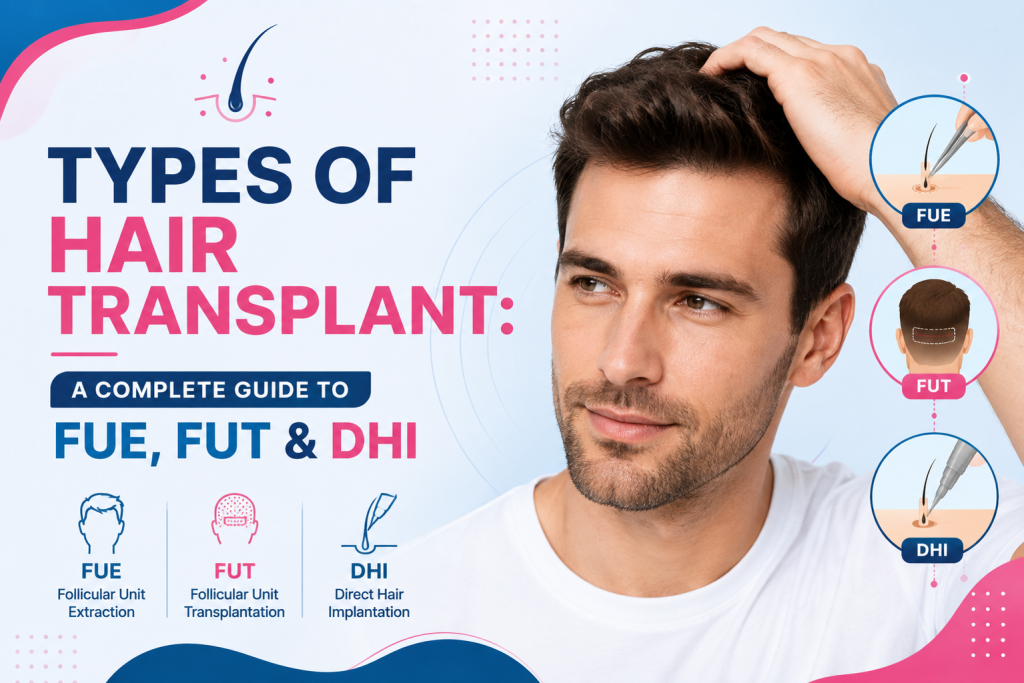
FUE (Follicular Unit Extraction)
Chances are FUE is the name you’ve already come across if you’ve done any digging. Here, the surgeon lifts out individual follicles one at a time from the donor area and resettles them into the thinning zones using very fine tools.
Because each follicle comes out on its own, there’s nothing to cut and nothing to stitch shut afterward. The scarring that remains is minor enough to be invisible once healed. There’s a catch, though: sessions can stretch on for hours, and the price climbs higher than older approaches. Still, for people who like keeping their hair cropped short, or for smaller sessions, this method tends to be the natural pick among hair transplant methods.
FUT (Follicular Unit Transplantation)
FUT takes a different route. Rather than extracting follicles individually, the surgeon removes a slim strip of scalp from the back of the head in one piece. That strip gets separated into single grafts under a microscope before those grafts go into the balding areas, same as with FUE.
This route generally runs cheaper and can tackle bigger bald patches without needing as many sessions. The downside is a thin linear scar where the strip came out, plus a slower healing stretch afterward. Anyone planning to grow their hair a bit longer won’t have much trouble hiding that mark.
DHI (Direct Hair Implantation)
DHI pushes the FUE concept a step further. Instead of cutting recipient sites first and placing grafts in afterward, the surgeon works with a pen-shaped tool that pulls out and inserts each follicle in one motion.
Skipping the pre-made incision step often gives finer control over the angle and thickness of new growth. Healing tends to move quickly, and any scarring left behind stays minimal. It’s a demanding, detail-heavy process though, which typically stretches session length and pushes the cost above standard FUE.
Some clinics now also offer robotic-assisted extraction, where a machine helps spot and remove follicles with added precision, though it’s still a newer and limited option.
How Do You Pick the Best Option?
Naturally you’re wondering which counts as the best hair transplant method for your situation. That answer shifts depending on a handful of things.
How extensive is your hair loss right now? Someone with a small thinning patch is in a different spot than someone facing widespread loss. Then there’s your donor area, dense or thinner? Budget matters too, along with how much recovery downtime fits your schedule.
There’s no single correct answer, which is why a proper consultation matters. At Skinovate, we start by examining your scalp and hearing your goals before pointing you toward FUE, FUT, or DHI, rather than pushing whatever’s trending.
Looking for a Hair Transplant Clinic in Pune?
Searching for a hair transplant clinic in Pune puts plenty of names in front of you, which works in your favor. What separates a clinic worth trusting from one that doesn’t come down to whether they take time to understand your specific case, instead of handing you a generic package.
Our surgeons at Skinovate walk through each route, FUE, FUT, or DHI, weighing it against your hairline goals and how much donor hair you realistically have. If hair transplant in Pune is what you’re researching, reach out and book a consultation for a straightforward read on what would work for you.
Ready to Take the Next Step?
Once you understand the types of hair transplant sitting in front of you, the decision gets a lot less intimidating. Whether it’s FUE’s near-invisible scarring, FUT’s lower cost, or DHI’s precision that catches your attention, the next move is a conversation with someone who can look at your scalp and your goals. Book a hair transplant consultation at Skinovate today.
