


Written by Skinovate Content Team | Medically Reviewed by Dr. Sushil Chaudhary On February 14, 2026
Table of Contents
- Introduction
- What Is Hair Thinning?
- What Is Hair Loss?
- Key Differences Between Hair Thinning and Hair Loss
- Common Causes for Both
- When to See a Specialist
- Conclusion
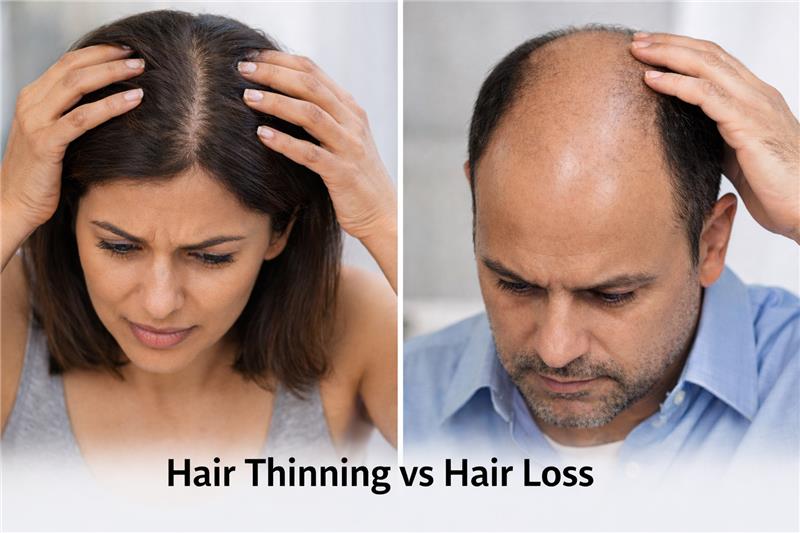
“My hair is thinning.” “I’m losing my hair.” People use these phrases interchangeably, and most of the time that’s fine in everyday conversation. But when you’re trying to work out what’s actually happening on your scalp, the difference matters.
There’s also a third thing that often gets mixed in: hair breakage. It can make your hair look thinner without a single follicle being affected, and it’s usually the easiest of the three to fix.
This guide explains the difference between hair thinning and hair loss, how breakage fits in, what causes each, how a dermatologist gets to the bottom of it, and when it’s time to stop guessing and get checked.
What is hair thinning?
Hair thinning means your hair is becoming less dense or finer over time, without large bald areas. You still have hair everywhere, there’s just less of it, or each strand is slimmer than it used to be.
You might notice that:
- your ponytail feels thinner than it did a year ago
- your parting looks wider
- your scalp is more visible under bright light
- your hair doesn’t hold volume the way it used to
It tends to happen gradually, which is why many people only realise after comparing old photos.
What is hair loss?
Hair loss is a broader term. It usually means you’re losing more hair than your body replaces, and it can range from a general increase in shedding to clear receding areas or bald patches.
Some signs of hair loss include:
- a lot more hair on your pillow, comb or in the shower than usual
- a receding hairline or thinning at the crown
- round or irregular bald patches
- hair coming out in clumps
It’s normal to shed somewhere around 50 to 100 hairs a day. Hair loss is when that clearly goes beyond your normal, or when the hair isn’t growing back.
In practice, hair loss and thinning overlap. Thinning is often the early, subtle stage of ongoing hair loss, and not everyone follows the same path.
Read Also : Top 10 Hair Care Tips to Control Hair Loss
Hair thinning vs hair loss vs hair breakage
|
Hair thinning |
Hair loss |
Hair breakage |
|
|
What’s happening |
Density drops or strands become finer |
More hair falls from the root than grows back |
Strands snap along the shaft |
|
How it looks |
Wider parting, reduced volume, visible scalp |
Receding hairline, bald spots, heavy shedding |
Short, uneven pieces, frizz, split ends |
|
Pace |
Usually gradual |
Gradual or sudden |
Often follows styling or damage |
|
Fallen hair |
Normal-looking, may be finer |
Often has a tiny white bulb at the root |
Short, no bulb, often split or rough |
|
Follicle affected? |
Often yes |
Yes |
No |
One quick check: pick up a fallen hair. If it has a small bulb at the end, it came out from the root. If it’s short and snapped with no bulb, it’s more likely breakage.
Be aware that these can occur together. Someone with early thinning may also be causing breakage with heat styling. That’s part of why guessing from appearance alone isn’t reliable.
Hair fall vs hair loss
You’ll also hear the term “hair fall,” especially in India. In everyday use it usually means increased shedding: more hair on the comb, in the drain or on the pillow, often after a trigger such as illness or stress. Hair loss is the wider term. It covers shedding that doesn’t settle, thinning, receding areas and bald patches. The wording matters less than how long it lasts and whether new hair is growing back.
How to tell what you’re dealing with
Ask yourself:
- Is it gradual or sudden? Gradual thinning over months or years often points to pattern hair loss. A sudden burst of shedding often follows a trigger like illness, stress or childbirth.
- Is it all over or in patches? Round bare patches suggest something different from general thinning.
- Where is it? A widening parting is typical in women, while a receding hairline and crown thinning are typical in men, although both can happen in anyone.
- Does your scalp itch, burn or flake? That points toward a scalp condition.
- What does the fallen hair look like? Bulb or no bulb, as above.
- What changed recently? New medicine, illness, crash diet, hormonal change, high stress or a new hair routine.
Jotting these down before an appointment helps your doctor a lot.
Common causes of hair thinning and hair loss
- Genetics and hormones. Pattern hair loss runs in families and is the most common cause overall. Over time, follicles gradually shrink and produce finer, shorter hairs. In women, hormonal conditions such as PCOS and thyroid problems can contribute.
- Stress, illness and major life events. Fever, surgery, childbirth, rapid weight loss and significant stress can push many hairs into the shedding phase at once, usually a couple of months after the event. This is called telogen effluvium. It’s typically temporary.
- Nutritional gaps. Low iron, low protein intake and other deficiencies may contribute to shedding. Taking random supplements isn’t the answer. Too much of certain nutrients can actually make things worse, so testing comes first.
- Medicines and medical conditions. Some medicines can cause hair shedding, and certain health conditions, such as thyroid disease, can affect hair.
- Autoimmune conditions. In alopecia areata, the immune system attacks hair follicles and causes patchy hair loss.
- Scalp conditions. Dandruff, fungal infections and inflammation can interfere with healthy hair growth.
- Styling and traction. Tight hairstyles can pull on the follicles over time, and harsh heat or chemical treatments weaken the hair shaft and lead to breakage.
Read Also: Can Stress Cause Hair Loss? Expert Dermatologist Guide to Stress Hair Loss
Hair thinning and hair loss in men vs women
The patterns tend to differ, though not always.
Men more often notice a receding hairline, thinning at the temples or a bald spot at the crown. Male pattern hair loss is very common and tends to progress without treatment.
Women more often notice a wider parting and diffuse thinning over the top of the scalp, while the frontal hairline usually stays in place. Hormonal changes during pregnancy, postpartum and menopause can trigger noticeable shedding.
Either way, both men and women deserve a proper assessment instead of assuming it’s “just genetic.”
How do dermatologists diagnose hair loss?
You may be surprised that a hair loss consultation is mostly detective work. A typical assessment may include:
- A detailed history. Your doctor will ask about family history, how and when it started, recent illness, stress, diet, medicines, hair-care habits and (for women) menstrual and hormonal history.
- A scalp and hair examination. Looking at the pattern of loss, the scalp condition and hair quality.
- A hair-pull test, when appropriate, to see how easily hair comes out.
- Trichoscopy. A magnified look at the scalp and hair roots using a special device, which helps identify the type of hair loss.
- Blood tests, if indicated. These might check iron levels, thyroid function, vitamin levels or hormones, depending on your symptoms.
- Occasionally, a scalp biopsy if the diagnosis is unclear or a scarring condition is suspected.
The point of all this is that treatment depends on the diagnosis. The same-looking thin patch can have very different causes needing very different approaches.
Treatment options for hair thinning and hair loss
There’s no one-size-fits-all fix, and what’s right for you depends on the cause. Hair thinning treatment and hair loss treatment both start with a diagnosis. Depending on yours, a dermatologist may suggest:
- Treating the underlying issue, such as correcting a deficiency, managing a thyroid problem or reviewing a medicine
- Topical or oral medicines for pattern hair loss, prescribed according to your situation. Some are not suitable for everyone, for example women who may become pregnant, so these should always be doctor-guided.
- Treatment for scalp conditions like dandruff or infections
- Procedures such as PRP therapy, where appropriate
- Hair transplantation for suitable cases of stable, permanent hair loss
- Better hair-care habits to cut down on breakage
Whatever the plan, any hair treatment for hair loss should be matched to the cause, not picked from an advert.
What is the best hair loss treatment?
There isn’t a single one. The best hair loss treatment is the one that fits your diagnosis: a deficiency needs correcting, a scalp infection needs treating, and pattern hair loss usually needs long-term, doctor-guided therapy. What works well for one person can do little for another, so be wary of anyone who names a “best” treatment before examining your scalp.
Treatments take patience. It often takes several months before you can tell whether something is working, and results vary from person to person. Be cautious of anyone promising a guaranteed regrowth.
Can hair loss and thinning be reversed?
Sometimes, yes. It depends on the cause and on how long it has been going on.
- Temporary shedding after illness, stress or childbirth often settles by itself as the trigger passes, though regrowth takes months.
- Deficiency-related thinning may improve once the deficiency is corrected.
- Pattern hair loss can often be slowed and sometimes improved with treatment, but it tends to be a long-term condition that needs ongoing management.
- Scarring hair loss damages follicles permanently, so early diagnosis is vital to protect the hair you still have.
- Breakage can improve with gentler care, though damaged hair needs to grow out.
The earlier you start hair thinning treatment, the more hair there usually is to save.
When should you see a dermatologist?
Consider booking an appointment if you notice:
- sudden or heavy hair shedding
- bald patches
- a steadily widening parting or receding hairline
- an itchy, painful, red, scaly or inflamed scalp
- hair loss that continues for more than a few months
- hair loss after starting a new medicine or after a major illness
- other symptoms such as tiredness, weight changes, irregular periods or excess facial hair
You don’t need to wait until it’s severe. In fact, early assessment is better.
Conclusion
Hair thinning and hair loss, along with hair breakage, can look alike, but they have different causes and need different solutions. Working out which one you have is the first and most important step.
If you’re unsure, a scalp examination can clear up the guesswork. At Skinovate, our dermatology team can look at your scalp, find out what’s behind the change and suggest a plan that fits your situation.
Noticing changes in your hair? Book a hair loss consultation and get a clear answer.
